
Is AI Bot Trading Software Better at Predicting Trends Than Humans? The Data Says Yes and No
The headlines make it sound like a done deal. AI trading bots processing 50,000 data points per second. Algorithms executing trades in milliseconds. Win rates exceeding 85%. It seems humans don’t stand a chance.
But here’s what the hype leaves out: AI algorithms that achieve 60 percent or more prediction accuracy are considered highly successful. That means even the best AI systems get it wrong nearly half the time. And yet, humans bring limitations of their own. Emotional bias, slower reaction times, and the inability to monitor markets 24/7.
So who actually wins?
This article breaks down the real comparison:
- Where AI dominates trend prediction
- Where human traders still have the edge
- What the Stanford study revealed about AI vs. human performance
- How DeepSeek and Tradingview.com fit into the equation
- Why the best approach combines both
No hype. No oversimplification. Just a clear-eyed look at what each side brings to the table.
Let’s dig in.
Where AI Dominates: Speed, Scale, and Consistency
When it comes to raw processing power, AI wins. No contest.
Data Processing at Scale
AI systems can process up to 50,000 data points per second, detecting patterns across fundamental, technical, and sentiment indicators that human traders might overlook.
A human trader staring at a chart might notice a breakout forming. An AI system analyses that same chart while simultaneously scanning:
- Historical price patterns across 30 years of data
- Real-time volume anomalies
- Social media sentiment from thousands of posts
- Correlated movements in related assets
- Order book depth across multiple exchanges
This isn’t about being “smarter.” It’s about bandwidth. Humans simply cannot process this much information at once.
Execution Speed
AI bots execute trades in 0.01 seconds, far quicker than humans at 0.1 to 0.3 seconds.
In high-frequency environments, that difference matters. Arbitrage opportunities disappear in milliseconds. A bot that reacts faster captures the profit. A human who hesitates misses the window entirely.
Emotional Discipline
Fear and greed destroy trading accounts. AI doesn’t experience either.
When a position moves against a human trader, panic sets in. They might:
- Exit too early, locking in unnecessary losses
- Hold too long, hoping for a reversal that never comes
- Increase position size to “make back” losses
AI systems enforce rules mechanically. If the stop-loss is set at 2%, it triggers at 2%. No exceptions. No emotional override.
Where Humans Still Win: Intuition, Context, and Adaptability
AI excels at pattern recognition within known parameters. But markets don’t always play by the rules.
Reading Between the Lines
AI bots dominate in speed, consistency, and scalability, while manual trading shines in adaptability and market intuition.
A human trader can interpret:
- Subtle shifts in a CEO’s tone during an earnings call
- Political developments that haven’t yet hit the news
- Sector-specific nuances that require industry expertise
- The “feel” of a market that’s about to turn
These qualitative factors often precede quantitative signals. AI can only act on data it can measure. Humans can act on hunches built from years of experience.
Unprecedented Events
Investment banks have utilized basic AI systems since the early 1980s, but these implementations failed to predict major market disruptions like the September 11th attacks, the 2007-2008 financial crisis, or the COVID-19 pandemic.
AI models are trained on historical data. When something truly unprecedented happens, they struggle. Black swan events break patterns. And by the time the AI “learns” the new pattern, the damage is done.
Experienced human traders recognize when the playbook no longer applies. They adapt in real-time, making judgment calls that go beyond what any algorithm can compute.
Breaking News and Regime Changes
Breaking News Events are more nuanced. When major announcements, like Federal Reserve interest rate changes or unexpected earnings reports, hit the market, AI bots react instantly to price shifts.
But reacting to price shifts isn’t the same as understanding why the shift happened. A human trader might recognize that the market’s initial reaction is wrong. They can fade the move, betting on a reversal. AI, following the momentum, might chase the trade in the wrong direction.
The Stanford Study: AI Beat 93% of Human Fund Managers
In 2025, researchers at Stanford and Boston College published a study that stunned the finance world.
The researchers created an “AI analyst” to study how much an AI bot, using nothing but public information, was able to improve on the performance of mutual fund managers. Between 1990 and 2020, fund managers had generated $2.8 million of alpha every quarter. When the AI analyst readjusted the human managers’ portfolios, it generated $17.1 million per quarter on top of the actual returns. AI beat 93% of managers over a 30-year period by an average of 600%.
That’s a staggering result. But context matters.
What the AI Actually Did
The AI wasn’t making bold predictions or timing the market. It used a systematic process:
- Analysed 170 variables correlated with future stock performance
- Sorted investments into 10 buckets based on expected returns
- Swapped underperforming assets for similar assets with better prospects
- Sold particularly bad holdings and moved proceeds into index funds
While adhering to this process, the AI altered roughly half of its entire portfolio of funds every quarter and increased returns sixfold over the 30-year market simulation.
The Caveat
The magnitude of these results is in no small part due to the fact that the experiment essentially travelled back in time, dropped an AI analyst on a single team, and gave that team a huge advantage. That doesn’t mean that the AI analyst could repeat its success in the current market, especially as more investors adopt similar tools.
As one researcher noted: “If every investor were using this tool, then much of the advantage would go away.”
How DeepSeek Changes the Equation for Retail Traders
You don’t need a Stanford research team to leverage AI for trend prediction. Tools like DeepSeek, combined with Trading View’s PineScript capabilities, give individual traders access to AI-powered strategy development.
What DeepSeek Can Do
In documented tests, traders used DeepSeek to:
- Analyze indicator logic: The AI broke down how indicators like the Reversal Trade Detector identify trend changes
- Generate PineScript strategies: Complete, compliable code with entry/exit conditions, stop-losses, and take-profit levels
- Add signal filters: Volume, RSI, trend confirmation, and ATR-based risk management
- Debug errors: When code failed, DeepSeek identified and fixed issues
One trader built a 4-hour trend-following strategy that generated over 700% backtested returns with a 60% win rate. Another created a 15-minute reversal strategy with 110% profit and a 72% win rate.
What DeepSeek Cannot Do
DeepSeek won’t:
- Guarantee profitable strategies on the first try
- Adapt to market conditions in real-time
- Replace your judgment on when to deploy a strategy
- Predict black swan events or regime changes
The AI generates code. You provide the oversight, testing, and risk management.
The Real Comparison: AI vs. Human Traders
| Factor | AI Advantage | Human Advantage |
| Speed | Executes in milliseconds | Slower reaction time |
| Data Processing | Analyzes millions of data points | Limited bandwidth |
| Emotional Discipline | No fear, greed, or bias | Prone to emotional decisions |
| 24/7 Availability | Never sleeps | Needs rest |
| Pattern Recognition | Identifies statistical patterns | Recognizes qualitative shifts |
| Adaptability | Struggles with unprecedented events | Adapts to new information |
| Context Understanding | Limited to measurable data | Interprets nuance and sentiment |
| Creative Strategy | Follows programmed rules | Innovates new approaches |
Neither side dominates across all categories. The question isn’t which is better. It’s which is better for what.
When AI Predicts Trends Better
AI outperforms humans in specific scenarios:
High-Frequency Environments
Arbitrage, scalping, and momentum trading on short time frames favour AI. Speed matters more than intuition when opportunities last milliseconds.
Data-Heavy Analysis
When the edge comes from processing more information faster, AI wins. Scanning thousands of securities for breakout patterns, analysing order flow, or detecting sentiment shifts across social media are all AI strengths.
Repetitive Execution
Strategies that require consistent, rule-based execution benefit from AI’s discipline. Grid trading, DCA, and mean reversion strategies perform better when executed without emotional interference.
When Humans Predict Trends Better
Humans outperform AI in different scenarios:
Unprecedented Market Events
During COVID-19, experienced traders recognized early that the selloff was overdone. Many bought the dip while AI systems, trained on historical crashes, predicted further decline.
Sector-Specific Expertise
A trader specializing in biotech understands FDA approval timelines, drug development cycles, and regulatory nuances. Generic AI algorithms miss these subtleties.
Sideways and Choppy Markets
Sideways or Range-Bound Markets tend to favor manual traders. Humans can identify consolidation phases and avoid false breakouts that often trap algorithms.
AI systems optimized for trending markets generate false signals in choppy conditions. Experienced humans know when to sit out.
The Hybrid Approach: Why the Best Traders Use Both
Approximately 80% of financial institutions worldwide have adopted or are actively exploring AI-powered trading systems, up from 65% in 2022.
But they’re not replacing human traders. They’re augmenting them.
How the Hybrid Model Works
- AI handles data processing: Scanning markets, identifying setups, generating signals
- Humans provide strategic direction: Deciding which markets to trade, setting risk parameters, overriding signals during unusual conditions
- AI executes trades: Fast, disciplined, emotion-free
- Humans monitor performance: Adjusting strategies when market conditions shift
This division of labor plays to each side’s strengths. AI does what it does best. Humans do what they do best. Neither tries to do everything.
Applying This to DeepSeek and Tradingview.com
The same principle applies to retail traders:
- Use DeepSeek AI to generate and refine PineScript strategies
- Backtest on Tradingview.com to validate performance
- Apply human judgment to decide when to deploy each strategy
- Monitor results and adjust based on changing market conditions
You’re not outsourcing your trading to AI. You’re using AI as a tool to amplify your capabilities.
The Limitations Neither Side Can Escape
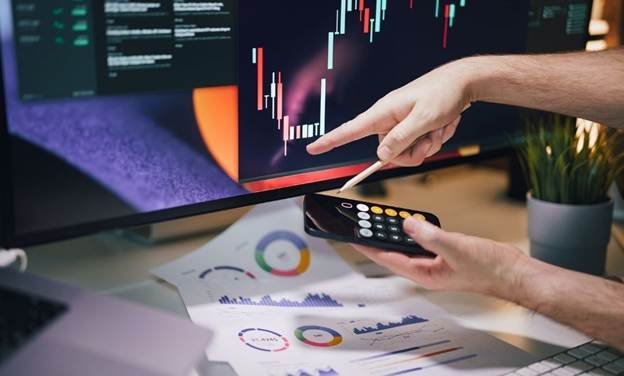
Some of the limitations include:
Markets Change
A strategy that works today may fail tomorrow. AI can adapt through retraining, but only after the damage is done. Humans can recognize shifts earlier but may lack the discipline to act on them.
Prediction Is Inherently Uncertain
No system, human or AI, can predict the future with certainty. The best traders manage risk so that being wrong doesn’t destroy them.
As one experienced trader noted, “You say there’s a lot of patterns in the stock market. There’s almost as many in pure noise.”
Both humans and AI can mistake noise for signal. Robust risk management protects against this inevitable error.
The Edge Erodes
When a strategy works, others notice. Arbitrage opportunities disappear as more traders exploit them. AI systems that once dominated become commoditized. Human insights that once provided an edge become common knowledge.
The only constant is the need to keep adapting.
Predict Trends Smarter with DeepSeek and Tradingview.com
The AI vs. human debate creates a false choice. The traders winning aren’t picking sides. They’re combining AI’s processing power with human judgment to build strategies that adapt, execute, and survive. Here’s what matters:
- AI processes data faster and executes without emotion. Speed and discipline are its superpowers.
- Humans read context, adapt to chaos, and recognize when the rules change. Intuition still matters.
- Stanford’s AI beat 93% of fund managers over 30 years. But the edge shrinks as adoption grows.
- 60% prediction accuracy is considered highly successful for AI. Even the best systems get it wrong often.
- The hybrid approach wins. Let AI handle data and execution while you provide strategic oversight.
- Risk management beats prediction accuracy. Neither side escapes uncertainty.
DeepSeek AI and Tradingview.com put this hybrid approach within reach for retail traders. Use DeepSeek to generate PineScript strategies, backtest them on Tradingview.com, then apply your own judgment on when and how to deploy. You get the AI’s analytical horsepower without surrendering control. That’s how you build an edge worth keeping.